


The Short Answer
Profit and cash are two different numbers. Your Profit & Loss (P&L) report shows what your business earned and spent. It does not show when customers actually paid, how much loan principal you repaid, or how much cash went into equipment and owner withdrawals. These can reduce your bank balance without reducing your profit.
A Common Situation
Picture a small service business owner. She opens her Profit & Loss report for the quarter and sees a net profit of $42,000. She feels good about it. Then she checks her bank balance: $3,100.
She calls her bookkeeper and asks a question we hear often: “If I made $42,000, where is it?”
Her books were not necessarily wrong. The report may be accurately showing business performance, but it is answering a different question from the bank balance.

Where the Profit Went
When the transactions were reviewed, the cash was not missing. It was sitting in other places.
1. Customers Had Not Paid Yet ($18,000)
Under accrual accounting, revenue is generally recognized when it is earned, not simply when an invoice is sent or when cash is received. If services have been delivered and the revenue recognition criteria are met, the amount may appear in the P&L while the customer payment remains outstanding. Review the Accounts Receivable (A/R) Aging report to identify unpaid invoices.
2. Loan Principal Was Repaid ($9,000)
A loan payment usually includes principal and interest. The interest portion is generally an expense, the principal portion reduces the loan liability. Both portions use cash, but principal repayment does not appear as a P&L expense.
3. Equipment Was Purchased ($7,500)
A qualifying equipment purchase is generally recorded as an asset rather than an immediate expense, depending on the applicable accounting framework and capitalization policy. Cash decreases when the equipment is paid for, while depreciation is recognized over its useful life.
4. The Owner Withdrew Money ($8,000)
For a business where owner draws are the appropriate classification, withdrawals are generally recorded against owner’s equity rather than as operating expenses. They reduce available cash without reducing P&L profit. The correct treatment depends on the business’s legal and tax structure.
The Simple Math
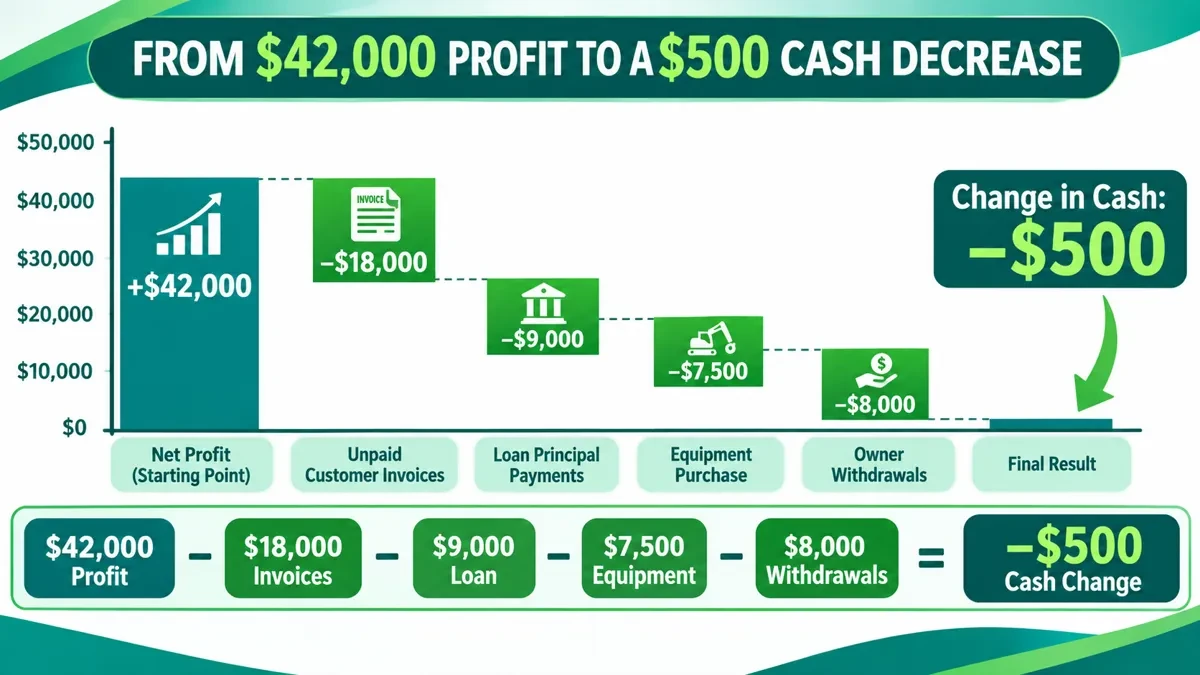
The following bridge illustrates how the $42,000 profit could coincide with a $500 decrease in cash, assuming the listed amounts represent the relevant cash-impacting movements for the quarter and there are no other material cash flow adjustments.
| FINANCIAL ITEM | AMOUNT |
|---|---|
| Net Profit (P&L) | $42,000 |
| Unpaid customer invoices | –$18,000 |
| Loan principal payments | –$9,000 |
| Equipment purchase | –$7,500 |
| Owner withdrawals | –$8,000 |
| Change in Cash | –$500 |
The bank balance started the quarter at $3,600 and ended at $3,100, which is a $500 decrease. The example is designed to show the relationship, not replace a formal Statement of Cash Flows.
Sometimes the P&L Itself Is Wrong
In the example above, the books were assumed to be accurate. In real bookkeeping reviews, however, the reported profit may also be misstated. Common causes include:
- Personal transactions incorrectly recorded as business expenses.
- Revenue recorded twice – for example, once through an invoice and again when the related bank deposit is added as new income instead of being matched to the payment.
- Payment processor fees or refunds not recorded correctly, causing revenue or net income to be overstated.
Before explaining a cash difference, first make sure the bank and credit card accounts are reconciled to the actual statements, and that the P&L and Balance Sheet are accurate. If they are not, the numbers you are trying to explain may not be reliable.
How to Check Your Own Books in 3 Steps
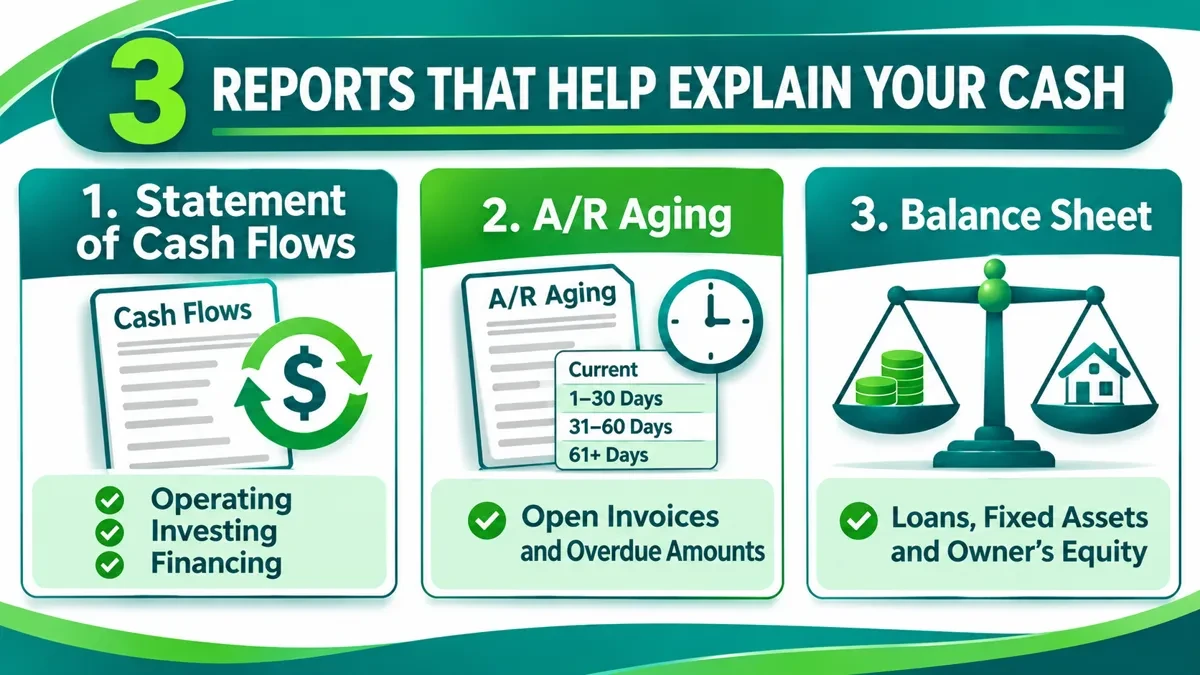
1. Run the Statement of Cash Flows
Review cash generated or used by operating, investing and financing activities. This report helps explain how profit relates to the period’s change in cash.
2. Open the A/R Aging Report
Identify unpaid customer invoices, how long they have been outstanding, and whether collection follow-up is needed.
3. Review the Balance Sheet
Check loan balances, fixed assets, owner equity, and other assets and liabilities. Compare opening and closing balances to understand what changed during the period.
Don’t Rely on Profit Alone
A profitable P&L does not automatically mean your business has enough cash available. If your business consistently reports a profit while the bank balance remains low, investigate the timing of collections, debt repayments, asset purchases, owner withdrawals, and the accuracy of the underlying records.
Profit shows how the business performed. Cash flow shows how cash moved. You need both views to make informed business decisions.
Need a Clearer Picture of Your Business Finances?
Accounting Touch provides bookkeeping cleanup, catch-up, and ongoing bookkeeping support to help businesses maintain accurate records, reconcile accounts, and gain better visibility into their financial position.
Not sure why your cash does not match your profit? Talk with Accounting Touch about reviewing your books.