
Accounts Receivable (A/R) represents amounts customers owe the business for goods or services already provided. When the A/R balance is inaccurate, the problem can affect customer statements, collection decisions, cash-flow visibility, and the reliability of financial reports.
An incorrect A/R balance does not always mean the entire bookkeeping file is wrong. In many cases, the balance is distorted by a payment that was not applied correctly, duplicate activity, an unapplied credit, an old receivable, or an incorrect historical/opening balance. The goal of cleanup is to trace the balance to real supporting records and correct the underlying issue.
What You’ll Learn
⦁ What A/R should represent and why an accurate balance matters
⦁ Five common reasons an A/R balance may be incorrect
⦁ How payment and invoice mismatches distort A/R
⦁ How to investigate an A/R discrepancy systematically
⦁ How to clean up old, duplicate, unapplied, or incorrect activity
⦁ What to check before and after an A/R cleanup adjustment
1. What Should an A/R Balance Represent?
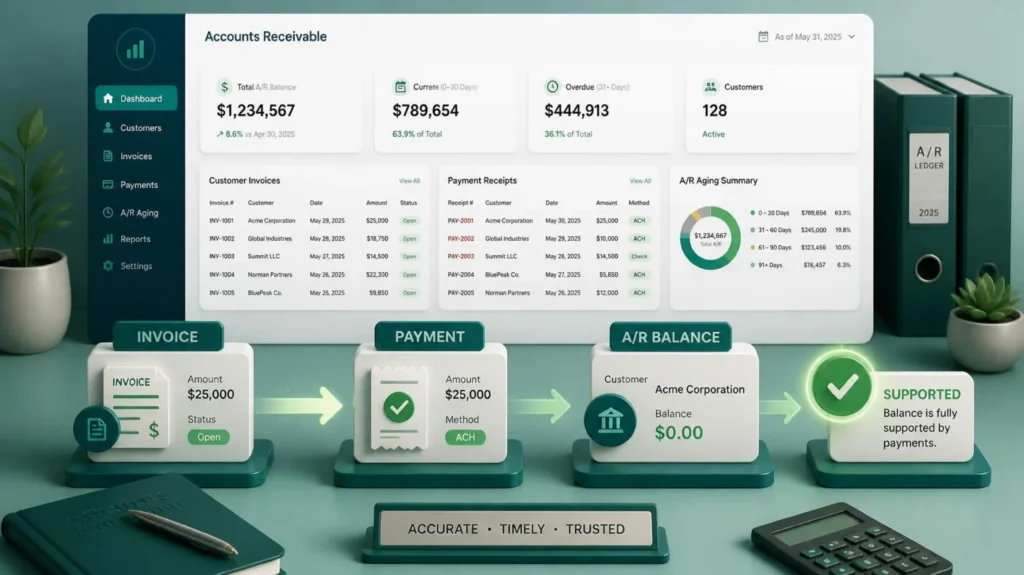
Think of A/R as a list of genuine amounts customers still owe the business. If a customer has already paid an invoice, that invoice should normally no longer appear as an outstanding receivable once the payment is properly recorded and applied.
For example, if a customer was invoiced $25,000 and paid $25,000, the customer’s outstanding A/R should normally be $0. If the payment exists in the bank but was recorded as an unapplied customer payment—or posted to the wrong customer—the books may still show an amount as outstanding even though the business has already received the cash.
A reliable A/R balance should be supported by customer-level detail, open invoices, payments, credits, and other relevant records. The A/R control balance should also make sense when compared with the A/R Aging report.
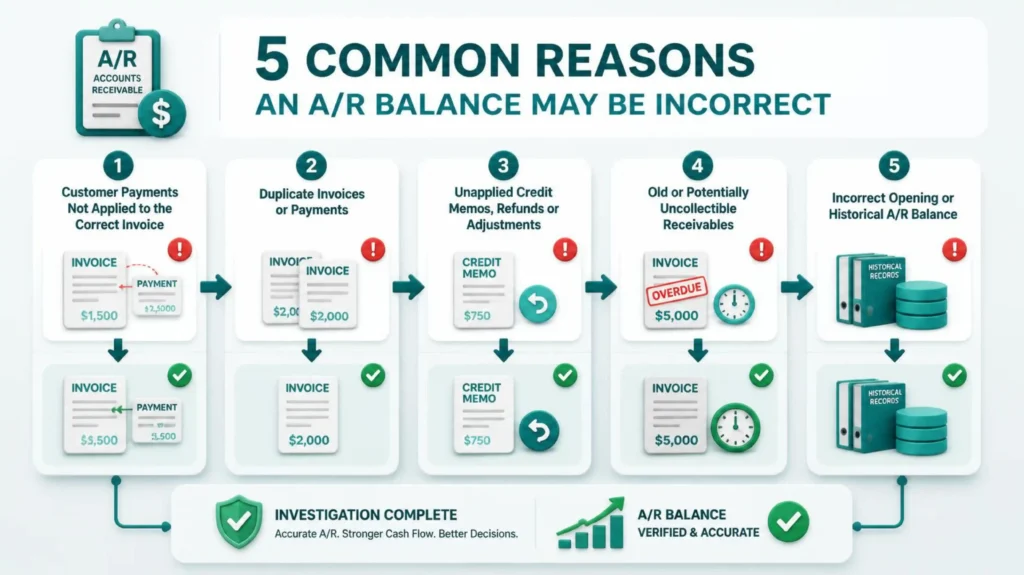
2. Five Common Reasons Your A/R Balance May Be Incorrect
Reason 1 — Customer Payments Are Not Applied to the Correct Invoice
A payment may be recorded in the books but not linked to the invoice it settles. This can leave an invoice appearing unpaid while the cash has already been received.
Look for:
⦁ Unapplied customer payments
⦁ Payments sitting as credits on the customer account
⦁ Invoices that remain open despite a matching bank deposit
⦁ Partial payments that were applied to the wrong invoice
Cleanup approach: Trace the payment to the bank or processor record, confirm the customer and amount, then apply the payment to the appropriate invoice or invoices.
Reason 2 — Duplicate Invoices or Duplicate Payments
Duplicate entries can overstate or distort customer balances. A duplicate invoice may make a customer appear to owe more than they actually do, while a duplicate payment can create an unexplained credit.
Look for:
⦁ Same customer, invoice number, date and amount appearing more than once
⦁ Two payments with the same amount and reference
⦁ Duplicate activity created during imports or integrations
Cleanup approach: Confirm the duplicate against source documents before deleting, voiding, or reversing anything. Do not create a second adjustment simply to offset the duplicate.
Reason 3 — Credit Memos, Refunds, or Adjustments Are Unapplied
Customer credits can reduce what a customer owes, but an unapplied credit may sit separately from the invoice it was intended to offset. This can make both the customer balance and aging report difficult to interpret.
Review credit memos, refunds, discounts, write-offs, and other customer-level adjustments. Confirm why each credit exists and whether it has been applied appropriately.
Cleanup approach: Match the credit or adjustment to supporting documentation and apply it to the correct customer/invoice when appropriate.
Reason 4 — Old or Potentially Uncollectible Receivables Remain Open
An invoice that has been outstanding for a very long time may no longer represent a realistic collectible balance. Keeping old items open without review can make A/R look stronger than the underlying collection reality.
Review the A/R Aging for older buckets such as 90+, 120+, or other policy-defined periods. Investigate customer correspondence, collection history, disputes, credits, and approved write-offs.
Cleanup approach: Determine whether the receivable is still valid and collectible. If a write-off or other adjustment is appropriate, follow the business’s accounting policy and approval process.
Reason 5 — Opening or Historical A/R Balance Is Incorrect
When a bookkeeping file is migrated, rebuilt, or converted, historical customer balances can be carried forward incorrectly. An incorrect opening A/R balance can then make the current A/R Aging appear wrong even when recent transactions are recorded properly.
Review the prior-period A/R detail, customer-level balances, closing reports, and source-system records. Trace unexplained opening balances before making a new adjustment.
3. How to Investigate an Incorrect A/R Balance
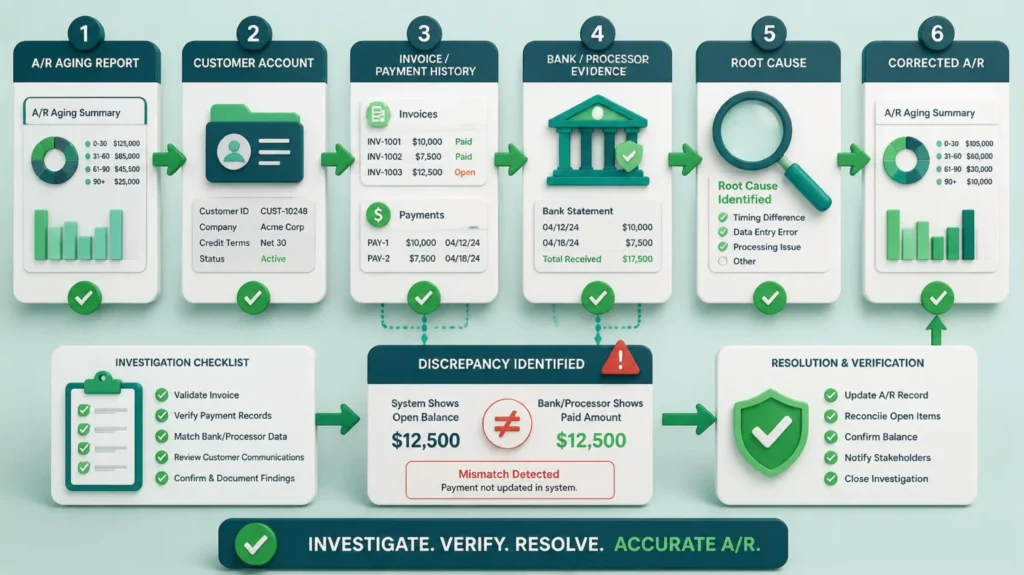
Do not immediately post a journal entry just because the A/R balance looks wrong. First determine what created the difference.
- Run the A/R Aging report as of the relevant date.
- Identify the customers or invoices creating the unusual balance.
- Compare the customer-level detail with the A/R control balance.
- Review open invoices and look for payments that may have been recorded but not applied.
- Check for duplicate invoices, duplicate payments, and unusual credits.
- Review old receivables and determine whether they are still valid.
- Trace opening or historical balances back to prior reports or the source accounting system.
- Compare unusual transactions with bank, payment-processor, invoice, and customer records.
- Document the root cause before making a cleanup correction.
- After the correction, rerun the relevant A/R reports and confirm the result.
A Simple Diagnostic Question
For every outstanding A/R amount, ask: ‘What real customer transaction supports this balance?’ If the answer cannot be found in an invoice, payment history, credit, contract, or other reliable record, the item deserves investigation
4. How to Fix the Problem Safely
The correct fix depends on the cause. There is no universal journal entry that should be used for every A/R discrepancy.
If a payment is unapplied
Verify the customer, amount and supporting bank/processor record, then apply the payment to the correct invoice(s) when appropriate
If a payment is applied to the wrong invoice/customer
Review the customer history and supporting evidence, then correct the application so the customer and invoice balances reflect the actual transaction.
If an invoice is duplicated
Confirm the duplicate using source documentation, then remove or reverse the duplicate according to the bookkeeping workflow.
If a payment is duplicated
Confirm both entries against source records and correct the duplicate rather than leaving an artificial customer credit.
If a credit memo or adjustment is unapplied
Determine the intended customer/invoice and apply or correct it based on the supporting documentation.
If an old receivable is no longer collectible
Follow the company’s approved write-off or adjustment policy; do not simply delete the invoice to make the aging report look cleaner.
If opening A/R is wrong
Trace the balance to prior-period reports and customer-level detail, then correct the underlying historical/opening issue with appropriate documentation.
Important: When correcting A/R, preserve an audit trail. A cleanup adjustment should explain what was wrong, why the correction was made, and what supporting evidence was reviewed.
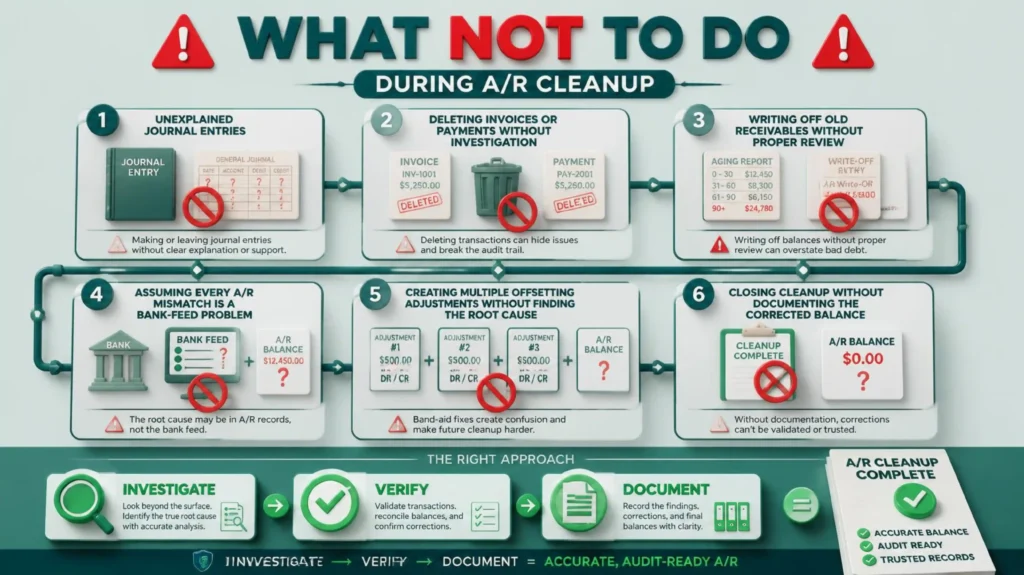
5. What NOT to Do During A/R Cleanup
⦁ Do not post an unexplained journal entry just to make the A/R balance equal a desired number.
⦁ Do not delete an invoice or payment simply because it makes the aging report difficult to reconcile.
⦁ Do not write off old receivables without reviewing whether they are actually uncollectible and following the appropriate approval process.
⦁ Do not assume every A/R mismatch is caused by a bank-feed problem.
⦁ Do not create multiple offsetting adjustments when the original cause has not been identified.
⦁ Do not close the cleanup without documenting the source of the corrected balance.
7. Final A/R Cleanup Checklist
☐ A/R Aging report reviewed
☐ Customer-level balances reviewed
☐ Open invoices verified
☐ Unapplied payments checked
☐ Duplicate invoices and payments checked
☐ Credits and refunds reviewed
☐ Old receivables investigated
☐ Opening/historical A/R traced
☐ Supporting bank/processor/source records reviewed
☐ Root cause documented
☐ Cleanup correction supported by evidence
☐ A/R Aging rerun after correction
☐ Customer balances reviewed after cleanup
☐ Financial statements checked for unexpected changes
An unusual A/R balance can be a simple application error—or a sign that the books need deeper cleanup. The safest approach is to trace the balance to reliable records, identify the root cause, and correct the underlying issue.
Is your A/R balance difficult to reconcile?
Let Accounting Touch help review and clean up your books.